People living during the Antebellum Era in America enjoyed and participated in a varied array of pastimes and leisure activities, providing for much-deserved reprieves from the labors and concerns of everyday life. Penny newspapers—so named because of their cost—were widely circulated and brought news and events to ordinary people, ranging from local concerns to state-wide issues, and covering national politics and news as well. The theater, in one form or another, was enjoyed by both the lower and upper classes of nearly every city in the country. Additionally, novels attracted reading enthusiasts with the publications of such classics as The Scarlet Letter, Moby-Dick, The Count of Monte Cristo, Wuthering Heights, and perhaps the most read book of the time, Uncle Tom’s Cabin. Gambling was also a widely popular activity, especially as it related to horse racing and card playing. Baseball, which was in its infancy, began to attract crowds in the late 1830s, and P. T. Barnum fascinated crowds with his bizarre and intriguing displays at carnivals and museums.
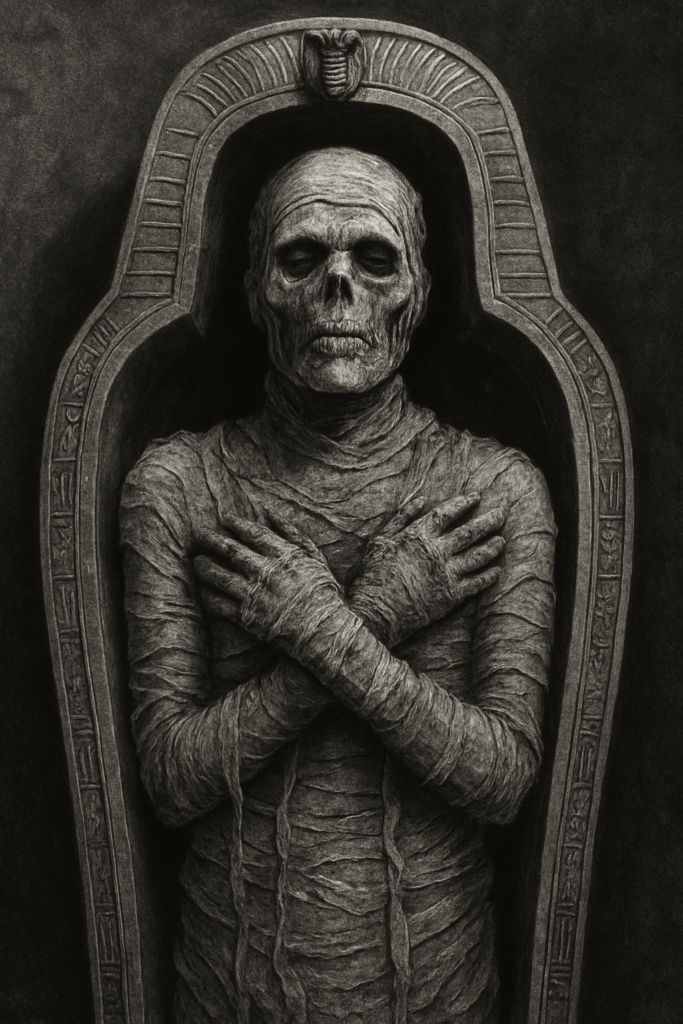
Like most of the world, and perhaps because of Barnum in the United States, the populace of the country was also incredibly obsessed with the dead bodies of ancient Egyptians—mummies. The curiosity and fixation on mummies were so passionate that the infatuation earned a name—Egyptomania. America’s fascination with mummies originated with discoveries made by the French while that country’s military was in Egypt. In 1799, Napoleon Bonaparte, his army, and a large contingent of scholars began the first known explorations of the pyramids and tombs of ancient Egypt. Although Napoleon’s stay in Egypt was interrupted because of military failures, his army made an amazing finding that is still discussed and debated to this day. While his soldiers were digging to establish a foundation for a fort near the town of Rashid, they unearthed what became popularly known as the Rosetta Stone. That intriguing piece of a larger tablet mystified scientists and scholars for decades until two men, Jean-François Champollion and Thomas Young, were able to decipher its ancient writings. Suddenly, the mysterious secrets of the pyramids and mummies were no longer an enigma. The Rosetta Stone brought ancient Egyptian hieroglyphics to life, revealing the stories and lives of mummies and providing significant insights into long-held questions in the fields of history and science.
At a time in the United States when people were reevaluating scientific research in relation to religious theory, mummies enlightened them to a new way of thinking. Mummies represented a link between science, religion, and medical research. The existence of embalmed bodies removed from graves gave people an opportunity to reconsider death and the afterlife in a much different way than mainstream religious factions were presenting. Thomas Pettigrew, a controversial scholar of time, inferred that the Egyptian methods of preserving the body after death through mummification could preserve the soul as well as the body. This, in turn, would allow for the soul and body to be intact on the day of resurrection.
Mummies benefited the medical field as well. Novel medications produced from bitumen, the primary tar-like substance used to embalm the dead, became available for use. The most valuable and effective bitumen used by the medical community was found in only one location, a mountain in Persia, which came to be known as “Mummy Mountain.” The bitumen seeping from this mountain, known as mūmiyā, was widely accepted as the same bitumen used by the ancient Egyptians to embalm their dead. However, that assumption was incorrect. It was not the same substance used by the Egyptians. But at the time, popular belief overshadowed reality, and the bitumen found in the cloth wrappings of ancient mummies was highly sought after for medicinal purposes. The bitumen substance became known as “mummia” or “mummy” and was not only extracted from human remains but also from dead animals that had been mummified along with their mummified owners. Regardless of the source, the material was highly coveted and contributed to a massive increase in grave robbing. Grave robbers boiled the bodies they stole, fully intact with their wrappings, in large vats. The boiling process caused a black residue—the bitumen—to rise to the top of the water. The residue was then collected, sealed in smaller containers, and sold through illegal markets to predominantly European merchants. The substance was then converted into a granulated powder or diluted liquid and sold to the public as a remedy for numerous ailments. People then used the “mummy” substance by mixing it into commonly ingested products, like milk, water, or wine. The “mummy” medicine claimed to be able to cure illnesses such as abscesses, throat infections, stomach problems, and was even used as an antidote for poisons.
The public around the world, but especially in the United States, believed mummies held the secrets to eternal life. They wanted to see the wrapped bodies of mummies for themselves, view their sarcophagi, gaze upon the treasures and riches buried with them, and witness firsthand if an ancient Egyptian incantation could bring a mummy back to life. Experts and entrepreneurs were well aware of the public’s fascination and yearning to view mummies in person and capitalized on that desire. Sponsors in the United States began to enlist the services of mummy scientists to bring unearthed mummy cadavers to the states, where “unrolling” and dissection exhibitions were offered to paying audiences. People rushed to purchase tickets for the dissections, intrigued by the prospect of viewing an actual mummy and hoping to gain insight into anything the sarcophagus, its contents, or the mummy inside could reveal. One well-respected Egyptology researcher and scientist, George Glidden, was so successful with his initial mummy “unrolling” in the United States that a group of investors backed him financially to tour several different cities.
George Gliddon was originally from England, but in the early 1800s, his family relocated to Alexandria, Egypt, where his father took the position of vice-consul in Cairo. While his father toiled at his job, George immersed himself in the culture and traditions of Egypt, especially as it related to mummies and ancient artifacts. His first visit to the United States was in 1837 when he was sent by Egypt’s ruler, Muhammed Ali, tasking George with the responsibility of assessing the possibility of purchasing equipment to open cotton and rice mills in Egypt. During his visit to America, he supplemented his income by giving lectures, primarily to scholars, doctors, and researchers, on various topics related to ancient Egypt. Gliddon’s second tour of the United States in 1842 was a ten-year lecture tour focusing on Egyptology. The American public was enthralled by him and eagerly paid the nominal fee for the chance to hear him speak of the lives of ancient Egyptians. During the same tour, Gliddon took a hiatus, travelling to Europe to persuade an English Egyptologist, Joseph Bonomi, to permit him to use a panorama of the Nile valley Bonomi had produced. With the help of apprehensive private investors, a business deal was eventually finalized, and Gliddon returned to the States with a magnificent moving panorama accompanied by topical Egyptian music, which he used to entice an already enthusiastic public to purchase tickets to his lectures.
Gliddon achieved significant success with his tour in both northern and southern cities. At that particular time, he was arguably more popular than the great showman P. T. Barnum. Audiences flocked to wait in line for hours for the chance to gain a ticket and hear Gliddon lecture. Gliddon was at the peak of his success, lecturing in front of thousands of both inquisitive amateurs and trained experts while unwrapping mummies he acquired from Egypt. It appeared that professionally, he could do no wrong. But, in 1850, Gliddon caused a public sensation from which he was unable to recover. The incident occurred in Boston and involved what he believed was an extraordinarily rare mummy that he had purchased for $1500 and intended to unwrap and dissect in front of large audiences. According to an article in the Litchfield Enquirer newspaper, his mummy was the remains of the Egyptian priestess, Anohph, the daughter of the High Priest of Thebes, Gotthoth I, who lived between 1200 and 1500 B.C.—around the time of Moses. Gliddon advertised the mummy in newspapers and public placards as the “Theban mummy,” a rare find that was entirely intact and meticulously preserved in an elaborately ornamented sarcophagus. The acquisition of a mummified priestess was a once-in-a-lifetime find and a noteworthy exception to the mummies that were commonly unearthed. An excited public eagerly anticipated the historic exhibition—an exceptional performance that promised to amaze and enlighten anyone who could attend.
Local newspapers extensively covered Gliddon’s presentations of his Theban mummy, which took place at Boston’s Tremont Temple in three separate viewings. During the first performance, Gliddon—while a carpenter sawed the Theban sarcophagus lengthwise to open it—lectured on unique topics relevant to the Nile valley. Once the top of the sarcophagus was removed, the mummy was carefully lifted from it, entirely intact, and placed on an elevated platform for all to see. It was anticipated that the sarcophagus would contain a plethora of jewels and trinkets, considering the mummy was that of a priestess, but none were found. Still, the audience was extremely engrossed with the exhibit and lectures and completely pleased with the day’s event.
During the second lecture date, Gliddon carefully and slowly unrolled the mummy’s outer wrappings while the captivated audience looked on. The body was entirely black, the result, according to Glidden, of being dipped in boiling bitumen during the preservation procedure. The mummy measured five feet, four inches, which Glidden proclaimed was the tallest mummified woman he had ever seen. Inside the sarcophagus, a mummified white ibis was discovered and consequently unwrapped for the audience. Other than a few articles that appeared to be clothing, there was nothing further revealed of the contents of the priestess’s coffin. It was noted that during the process of removing the linen bandages from the mummy, a fine dust from the deterioration of the bandages drifted through the auditorium, causing many of the paying patrons to begin sneezing.
The third and final lecture took place at the same theater in the evening. Glidden presented the mummy for audience viewing while providing an account of the early burial methods of the Egyptians, including the actual embalming process, explaining that embalming was probably developed because individuals requested that they be buried in particular locations. The need to travel with a deceased corpse, therefore, necessitated preserving the body for the journey. As a result, embalming was an essential requirement. Gliddon had already removed most of the resin from the Theban mummy and was in the process of removing the last of the bandages from the torso when an astonishing discovery was made. As Gliddon tossed aside the last remaining linens from the mummy’s hips and groin area, the audience reacted with a loud gasp of surprise. Apparently, the priestess was not a priestess after all. She lacked the anatomical characteristics typically associated with females. In fact, she had the anatomical characteristics of a male. The priestess had a penis!
Gliddon tried to vindicate the obvious error in his identification of the mummy by stating the inscriptions on the sarcophagus clearly indicated a female was inside. He asserted the mistake was probably made by the priests who embalmed the body, and insinuated that it was not unusual for a male body to be found in female coffins and vice versa. He then read aloud to the audience letters supporting his pronouncement that the sarcophagus was indeed brought from Egypt and contained that of a priestess. The audience was disappointed, to say the least, but did not appear to hold any resentment or ill will toward Glidden for his blunder. However, in the end, the embarrassing debacle severely damaged his public image and reputation as a prominent expert in Egyptology.
Glidden eventually vacated his tour in the northern states and concentrated his efforts in the southern region of the country. But he was experiencing significant financial difficulties. It was expensive to travel, even more so with such a large panorama to move around the country. As well, his investors were reluctant to provide ongoing support for his tour. Likely because of his diminishing popularity after the Theban mummy fiasco. Ultimately, Gliddon abandoned the tour, leaving his panorama in New Orleans, where he had last performed at the Lyceum Theater. He relocated to Honduras in Central America. There, he found employment as an agent with the British-Honduras Railway. But the position did not work out for him because of unexplained animosity toward him from many of the company’s employees. There are indications he was suffering from yellow fever, a very deadly disease of the period, and may have been self-medicating his illness with laudanum or opium or both. Either way, the drugs could very well have complicated his condition. Glidden’s final destination was a hotel room in Panama. There he died on November 16, 1857, at the age of forty-eight.