The Antebellum Era was a period of significant transition in the United States characterized by substantial political, economic, and social changes. Economically, in the North, the region was transforming from a fundamentally agricultural market to an expanding and robust manufacturing and market-based economy. In the South, the flourishing cotton industry, with its forced labor foundation, remained dependent on agriculture. Nationally, debates focusing on the country’s territory expansion—especially after the massive land acquisitions in 1848 from victory in the Mexican War—were creating complex narratives, predominantly related to the expansion of slavery into new and anticipated land acquisitions. Social movement organizations were flourishing, chiefly driven by the abolitionist movement, the fight for women’s rights, and religious crusades that were spreading across the country.
In the realm of religion, the attitudes of thousands of Americans were being radically—at least for the era—influenced by scientific advancements and theories. Contemporary findings in various fields of science were generating controversial dialogues between scientific scholarship and the traditional theology of Christianity. Scientific inquiry and philosophy offered people the opportunity to reevaluate their standard religious belief systems by presenting new and different means of understanding the natural world and various aspects of their personal lives. The masses were beginning to question the theocracy of the church. People did not abandon religion by any means. Still, advancements in social and scientific theology generated paths of possibilities for them to explore and pursue alternative rationalizations concerning their redemption, salvation, and eternal life beyond the edicts of Christian religious factions.
One particularly influential movement that fueled religious change during the Antebellum Era was the Second Great Awakening. This period of religious reformation began in the late 1700s and extended into the middle of the 1800s. The Second Great Awakening utilized revival meetings to reach the general public, especially those questioning what many considered to be archaic canons of the Church. The movement was open to everyone, no matter their gender, race, social standing, or economic status. As long as the prospective convert earnestly accepted the teachings of Christ, their salvation was assured for them. Revival sermons made daring assertions that everyone, not just religious leaders, could attain a personal and direct relationship with God’s salvation. This spirited declaration resonated and found deep appeal within the discontented masses who felt alienated and frustrated by specific doctrines of certain factions within the Church. They found validation in the opportunity to have control of their religious destiny, knowing that they alone controlled their path of achieving salvation and redemption.
The religious reform of the Second Great Awakening laid the foundation for an unexpected social reform movement that attracted an enthusiastic and continuously increasing multitude that was accepting of unconventional answers to their religious problems. That reform movement was Spiritualism. Spiritualism challenged the traditional views of how people understood themselves and the world around them. For most individuals, tradition and customs, supported by religious doctrine, shaped beliefs about the natural world and how each person interacted with it. Spiritualism offered a mystical alternate world of existence with its fundamental assumption that when a person dies, it is not an ultimate or final conclusion to their life. Spiritualism stressed that the souls of those deceased continued to live on in the afterlife as perpetual spirits. This spiritual world was mystically synchronized with the earthly realm, which permitted communication in various ways between the living and the dead. This innovative link provided a means for the living to interact with loved ones who were deceased through participation in supernatural, real-time, ritualistic meetings (séances) facilitated by a medium. These séances offered a remarkable sense of consolation to people who were suffering from grief. This was particularly true for those who had lost a family member, especially a child. The whole experience turned into a genuine source of hope, providing an avenue for once again connecting to their loved ones who had passed away.
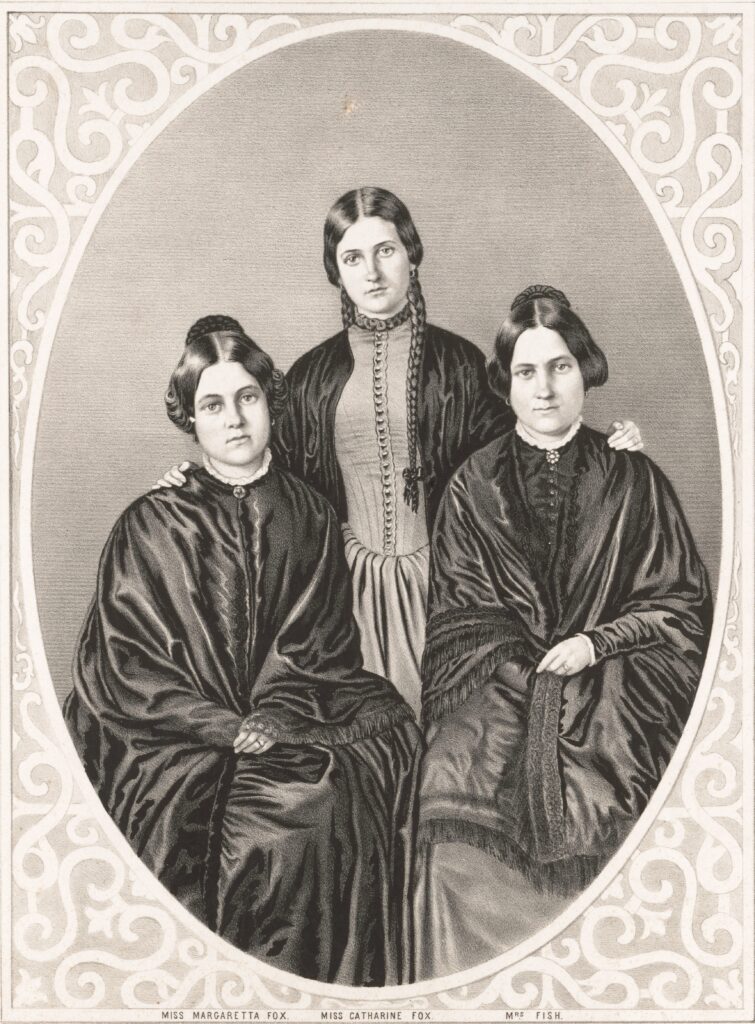
Though previous mystical-type phenomena were reported at various times in the United States, the birth of Spiritualism in America is attributed to two young girls who lived on a farm in Hydesville, New York. The Fox family occupied a small house on the farm and consisted of John Fox, his wife Margaret, and their two daughters, Margaret (Maggie), fourteen years old, and Catherine (Kate), eleven years old. There was a third daughter named Leah, but when the mystical spirits began visiting the Fox house, Leah was already married and living with her husband about twenty miles away in Rochester, New York. The Fox family was fairly new to the community of Hydesville, but for a few previous and resolved family issues between Mr. and Mrs. Fox, they fit well in the community. They had regular friends, were well respected, and nothing appeared out of the ordinary with them. That was about to change!
In the middle of an otherwise quiet night, Maggie and Kate, both frightened, left their sleeping area and went into their parents’ bedroom, where they awakened their mother. Once Mrs. Fox was able to calm the girls down, they explained that they were scared because a strange spirit was communicating with them by making loud “rapping” noises. Mrs. Fox was skeptical, but moved the girls’ bed into her and her husband’s room. The spirit apparently followed the girls into their parents’ room because the loud rapping noises continued a couple of hours later. When Mrs. Fox investigated further, she saw Kate interacting with the spirit, whom Kate called Mr. Splitfoot—a contemporary reference to a demon or devil—by clapping her hands and snapping her fingers in response to the spirit’s rappings. Mrs. Fox later reported that as soon as Kate clapped or snapped her fingers, there was a reciprocal rapping sound. Mrs. Fox challenged the spirit by asking it to name the ages of her children. The spirit correctly rapped the ages of her children! She continued to question the spirit and was able to determine that the spirit was that of a man, thirty-one years old, who had previously lived with his family in the Fox house and had been murdered, and his remains were buried in the cellar.
After several days, Mrs. Fox called on a trusted neighbor to visit and give her opinion of the rapping sounds. The neighbor, Mrs. Redfield—known to be a straightforward woman—had already heard rumors of the Foxes’ strange visitor and gladly accepted. Mrs. Redfield engaged the spirit by asking it questions about her own family. The spirit answered all of them with stunning accuracy! Over the following days, other curious neighbors visited the Fox house, and they too were able to communicate with the spirit. They found through the spirit that the murderer was a man who had killed the spirit on a Tuesday night with a butcher knife during a robbery of five hundred dollars. According to the spirit, the man hid the dead body, but returned the next night and buried him ten feet below the dirt floor of the cellar. An attempted excavation of the cellar produced some hair and bone fragments that a local doctor believed could be human, but no other evidence was located.
Local gossip about the strange and mystical happenings at the Fox house spread from the community to statewide and eventually gained national attention. There were so many strangers visiting the house that the Fox family was forced to move out. But their vacancy did not stop the influx of hundreds of people regularly descending on the town of Hydesville to see what most were referring to as a haunted house and hopefully experience a supernatural phenomenon for themselves.
Maggie and Kate became an overnight sensation. They were followed everywhere they went by inquisitive devotees as well as by meddlesome cynics. Their popularity grew so quickly that their older sister, Leah, convinced her mother that Maggie and Kate should come live with her until the sensationalism of the events died down. Mrs. Fox agreed, and Maggie and Kate moved to Rochester with their older sister. But the sensation did not die down, so Leah decided that instead of trying to hide away from the public’s attention, they should present the girl’s strange capabilities directly to the public by setting up public sittings for the girls and charging an admission fee. It wasn’t long before the Fox sisters, escorted and managed by Leah, were travelling and holding private and public séances, for astonished and paying patrons. Even at the cost of one dollar per attendee, the public was enthusiastic to have the opportunity to visit with the famous Fox sisters. At times, the girls held three group séances a day and, when time allowed, held private sessions in between.
As admired as the Fox sisters were, skeptics of their abilities followed in like numbers. Some believed the sisters were somehow fraudulently creating the rapping noises during their sittings. Others noted that many specific questions asked during seances were incorrectly answered or could not be answered at all. Then there were those who strongly felt that séances and mediums that performed them were connected to demonic forces that supported concepts that violated religious doctrines. These committed religious factions led to angry mobs searching out and confronting the Fox sisters, oftentimes in the middle of séances. Consequently, investigations into the abilities of the Fox sisters intensified until an assembly of respected newspaper writers concluded after an investigation that the Fox sisters’ tactics were fraudulent, meant to mislead their patrons into believing they were interacting with a supernatural sphere of existence. Finally, a trusted relative who the Fox sisters taught their tactics revealed that they were indeed deceptive schemes meant only to earn money from a gullible public.
The relative, Mrs. Culver, revealed that the Fox sisters were creating the rapping sounds at their séances by snapping their toes together. They would soak their feet in warm water, which helped increase the intensity of the sound of the toes snapping together. Between private or public sittings, the girls would conceal themselves out of public view and resoak their toes to be ready for the next session. Mrs. Culver stated that she, too, was able to produce the same sounds as the Fox sisters after only a week of practice using the same toe soaking method. Years later, the confirming disclosure of their deception came from Maggie, who publicly explained that she and Kate devised a plan in their home in Hydesville to create rapping noises by dropping an apple from a string until it hit the floor, making a knocking sound. The toe snapping procedure came soon after when they realized they needed to produce the rappings during daylight hours. A practice they perfected while living with their older sister, Leah.
Though Maggie rescinded her confession in later years, her initial admission was not well received by the Spiritualism community. It was a definite setback, but it did not signal the movement’s demise. People still regularly attended séances throughout the remainder of the 19th century. The medium-led sittings provided a novel experience for a population searching for answers about life and death. It gave them hope that an immortal soul continued to exist in the afterlife and, as such, could be communicated with by the living. Although the Golden Age of Spiritualism was over with the exposure of the Fox sisters, it persisted well into the 20th century and continues to be practiced to this day in some regions of the country.