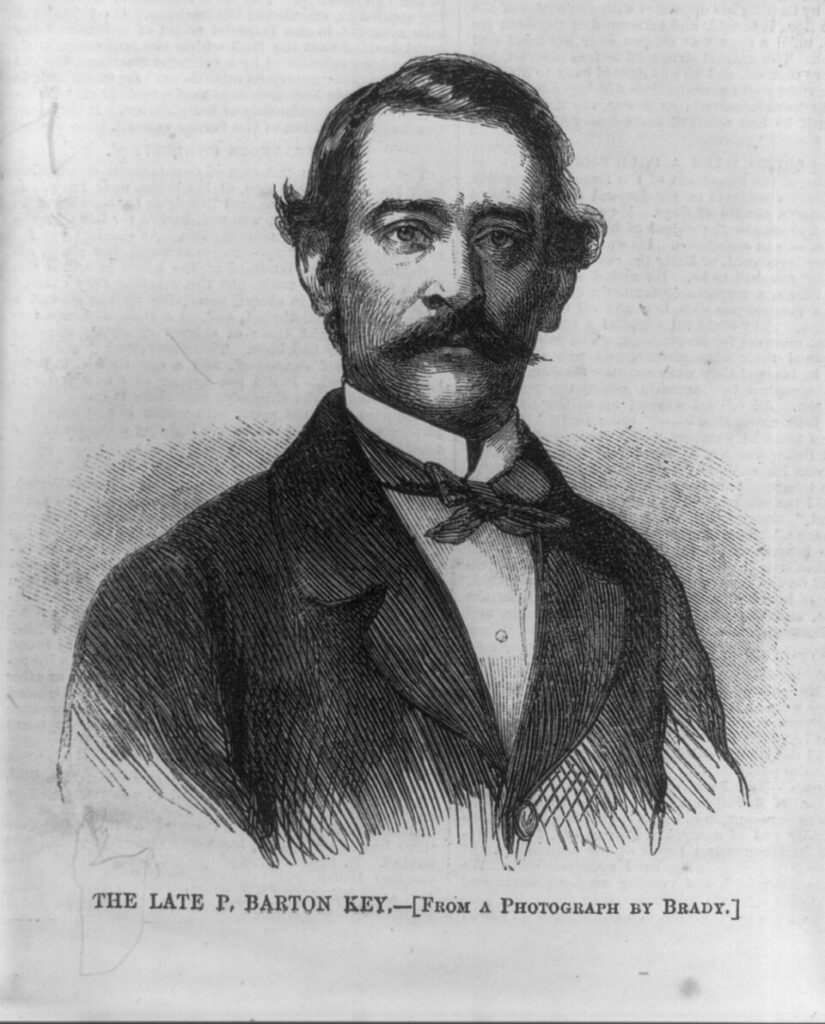
On a fateful morning in 1859, the newly formed friendship between Philip Barton Key and Daniel C. Sickles ended tragically on a street outside Sickles’ home in Washington, D.C., shortly after an anonymous “poisonous pen letter” was sent to Sickles.
Philip Key was born in Washington, D.C. He held the prominent and prestigious office of United States Attorney for the District of Columbia, having been appointed to the position by President Franklin Pierce in 1853 and confirmed by the Senate in 1854. He was nominated for and subsequently confirmed for a second term that began in 1858. Philip was the son of Francis Scott Key, also an attorney, and best remembered for his poem “Defense of Fort Henry,” which eventually was set to music and established as the American national anthem—the “Star Spangled Banner.” Philip Key was a highly popular figure in Washington’s political circles as well as among the city’s socialites. He was purported to be a handsome, charming, and charismatic figure with a rumored reputation as quite a “ladies’ man.” A trait that would soon become problematic for him.
Philip was befriended at a card game by another, more experienced congressman from New York, Daniel E. Sickles, who also lived in D.C. with his wife, a woman half his age, Theresa Sickles, nee Bagiola. Sickles held several political offices before his election to the U. S. Congress in 1856 and was not immune to scandalous behavior. The New York State Assembly once censured him for his public relationship and companionship with a well-known prostitute named Fanny White while he was married. Sickles was known to be short-tempered and best described as bold and reckless in his actions. He was flamboyant, ambitious, and a “man of honor.” He was well respected, and he and his wife were deeply entrenched in Washington society. These qualities carried significant weight in the politically charged atmosphere of 1858 Washington, D.C.
Although Theresa was young and inexperienced interacting with the often judgmental and aloof cliques of Washington, she presented herself well. She gradually acclimated to a community characterized by its constant nightlife of social clubs, restaurants, and theaters. As a couple, the Sickles were known to host extravagant dinner parties at their Lafayette Square home, across from the White House. Those functions were attended by the community’s most socially influential and politically powerful upper-class “movers and shakers” of the era.
In the constant pandemonium of national politics, congressional members often found themselves obligated to their duties, regularly working late into the evenings, struggling through never-ending debates and contentious policy-making. Their relentless responsibilities left many wives feeling the weight of isolation, as was the case with Theresa Sickles. With her husband preoccupied by the demands of his work, Theresa longed to be part of the exciting events occurring in the city’s nightlife. The attraction of dazzling theaters, lively music halls, and elegant get-togethers called to her, offering a much-desired opportunity to immerse herself in a world brimming with energy and excitement. The problem for Theresa was that the unwritten rules of society considered it scandalous for a married woman to be out alone at night. Attending social gatherings of any kind unaccompanied by a male was deemed a transgression that could easily and quickly lead to becoming a social pariah.
However, it was commonplace and socially appropriate for single or married women—with the consent of their husbands or family patriarch—to be accompanied to evening activities by a previously designated male companion. Theresa took advantage of this acceptable circumstance and was seen at social events escorted by a family friend named Henry Wilkoff, whom the Sickles’ knew from New York and whom Mr. Sickles regarded as a principled gentleman with integrity and honor. But, more often than not and more frequently as time passed, Mrs. Sickles was seen at events accompanied by Mr. Sickles’ new friend, Philip Key.
It wasn’t long before the shrewd eyes of society’s judgmental citizens began to take notice of the cautious yet undeniable bond that had materialized between Theresa and Philip. It had become apparent that what started as mere companionship, socializing at various events, had progressed into a relationship of implicit understanding and affection. Their company began to draw curious glances and whispered gossip among those alert enough to recognize the true nature of their relationship. To make matters worse, the public’s suspicions were correct! Theresa and Philip, shortly after their initial night out, had become involved in a passionate sexual affair. This was highly scandalous, not only for Philip and Therea, but also for her unknowing husband, Daniel. In Antebellum America, public scandals could easily result in social disaster for all those involved, regardless of their political power or standing in the community. As well, an illicit sexual affair was an indisputable affront to any husband’s honor.
Although Daniel Sickles was unaware of his wife’s infidelity and his new friend’s treacherous behavior, he was inherently cautious about Philip simply because he had not known him for an extended period. Daniel forbade Theresa from having any visits from Philip at or in their home when he, Daniel, was not present. He also made it unmistakably clear to Theresa that any conversations in public with Philip without his permission were strictly forbidden without his prior approval. Women of the era were expected to behave and present themselves in a manner that was considered acceptable. Their behavior in public or private was a matter of honor for Antebellum men, and any insult to a man’s honor during the period was likely to result in dire consequences.
The affair between Philip and Theresa went undiscovered by Daniel for some time. Then on February 12, 1859, Daniel Sickles received an anonymous “poisonous pen letter.” He did not immediately open the note because he and his wife were running late for a party they were expected to attend. The following day, as part of his daily business, Daniel opened the letter and was stunned at its contents. The letter, signed “Your friend, R.P.G.,” went into a vivid description of the salacious affair between Philip and Theresa. Daniel remained calm—a feat in itself considering his volatile character. He contacted a close friend, requesting that the friend investigate the validity of the letter’s contents with the utmost discretion. Much to Daniel’s anguish, his friend reported that the affair had been ongoing for about a year. His friend continued that Philip and Theresa had met at times in the Sickles’ house and at other times in a rented house within walking distance of the Sickles’ residence. Needless to say, Daniel was livid with anger and personally humiliated. He immediately confronted his wife about the allegations. His state of mind was such that Theresa dared not deny the accusations. She confessed!
Theresa admitted that the affair began sometime in April or May of the previous year, and she had been with Philip on numerous occasions. They met in their house—the Sickle home—when Daniel was out of town on business, but predominantly in a house close to the Sickle home, Philip rented exclusively for their disgraceful rendezvous. Theresa admitted her behavior was shameful, disreputable, and that only a “wicked woman” would have allowed herself to carry on the affair. Fuming, Daniel listened to his wife describe her adulterous encounters with Philip, and when she finished, he demanded she put the entire affair in writing. He intended to keep and present the written confession to his associates and other community members as a means of preserving his honor and social status. Whether intentional or by chance, the letter found its way into the media, and Theresa’s affair was printed in numerous newspapers for all to read and ponder. Theresa’s status and position in Washington, D.C., society came to an abrupt end. She became labelled as a tainted woman and unworthy of any consideration within the community.
However, the story is far from over; in fact, it is just beginning! As Sir Walter Scott so eloquently stated, “Oh, was a tangled web we weave when first we practice to deceive,” in his poem “Marmion,” so the tangled web of Theresa’s affair continues. As fate would have it, the morning after her confession, Daniel noticed Philip impatiently walking back and forth near a window outside the Sickle home. He appeared to be—as discreetly as possible—waving a handkerchief as a signal to Theresa to meet him at the house where they had carried on their affair. Daniel could no longer hold back his rage toward his corrupt acquaintance. It was bad enough that Philip had betrayed their friendship, but now he had the audacity to again publicly insult Daniel by attempting to communicate with his wife after their affair had become public knowledge.
Daniel immediately sent a message to a friend, S. F. Butterworth, requesting that the friend respond to Philip’s location outside his house and engage him in a cordial conversation until Daniel was able to prepare to meet them and confront Philip properly. Mr. Butterworth complied. As Philip and Mr. Butterworth exchanged pleasantries across from the White House in Lafayette Square, Daniel fanatically approached the two men and shouted to Philip, “Key, you scoundrel. You have dishonored my home. You must die!” Key immediately raised his hand to his chest, perhaps in shock or in an attempt to retrieve a weapon to defend himself. In any event, Daniel quickly drew a pistol from a pocket in his overcoat and fired. The shot took effect, striking Philip in the groin area. The two men grappled with one another for a few seconds, and when they disengaged, Philip rapidly retreated up the street. Daniel, obsessed with not killing Philip with his first shot, pursued him. When he was about ten feet from his prey, Daniel fired his pistol two more times. Both shots entered Philip’s body close to his heart. He fell to the pavement dead.
Immediately after the shooting, Daniel walked to the nearby office of Attorney General Jeremiah S. Black and surrendered. News of the murder spread quickly among the tight-knit community of Washington, D.C., and mixed emotions defined how people felt about the encounter. Philip Key’s friends viewed the killing as simply a cold-blooded murder of a defenseless man. The opposing viewpoint was that the death of Philip was an appropriate response from Daniel for being grossly dishonored by Key. A local magistrate was summoned to the Attorney General’s office, and Daniel was officially placed under arrest. He was transported to the local jail under heavy police protection as crowds of people gathered, who, it was feared, might attempt to seek revenge against Daniel for Philip’s murder. Daniel Sickles refused bail, perhaps wisely, choosing to remain in jail until his trial took place. A trial that was not only unique but significant in American law.
The trial began on April 4, 1859, after four days were spent selecting a jury consisting entirely of white males. Spectators for and against Daniel crowded into and outside of the courthouse, hoping to experience the trial first-hand. The prosecutor, District Attorney Robert Ould, planned to present a straightforward case. Philip Key, an unarmed man, was murdered in cold blood as revenge for his affair with Daniel’s wife. The defense planned a different strategy. Daniel’s defense counsel was a skilled and experienced legal team, with one member of the team having experience with the defense of insanity based on “moral insanity,” a legally explained form of permanent insanity caused by an incident involving extreme moral outrage. The defense intended to argue that Daniel did not experience a permanent “moral insanity,” but instead, he suffered from a temporary insanity because of his moral outrage associated with confronting the man who was having an affair with his wife.
The trial lasted for twenty-two days. Each day, the courtroom was packed with anxious supporters and opponents of the defendant. When the jury foreman announced the verdict that Daniel Sickles was “Not Guilty” of murdering Philip Key, the courtroom erupted in applause from some and audible disgust from others. In the end, Daniel Sickles was a free man and the first in American law to have successfully been acquitted using the defense of temporary insanity. A defense that is now commonplace in legal trials.