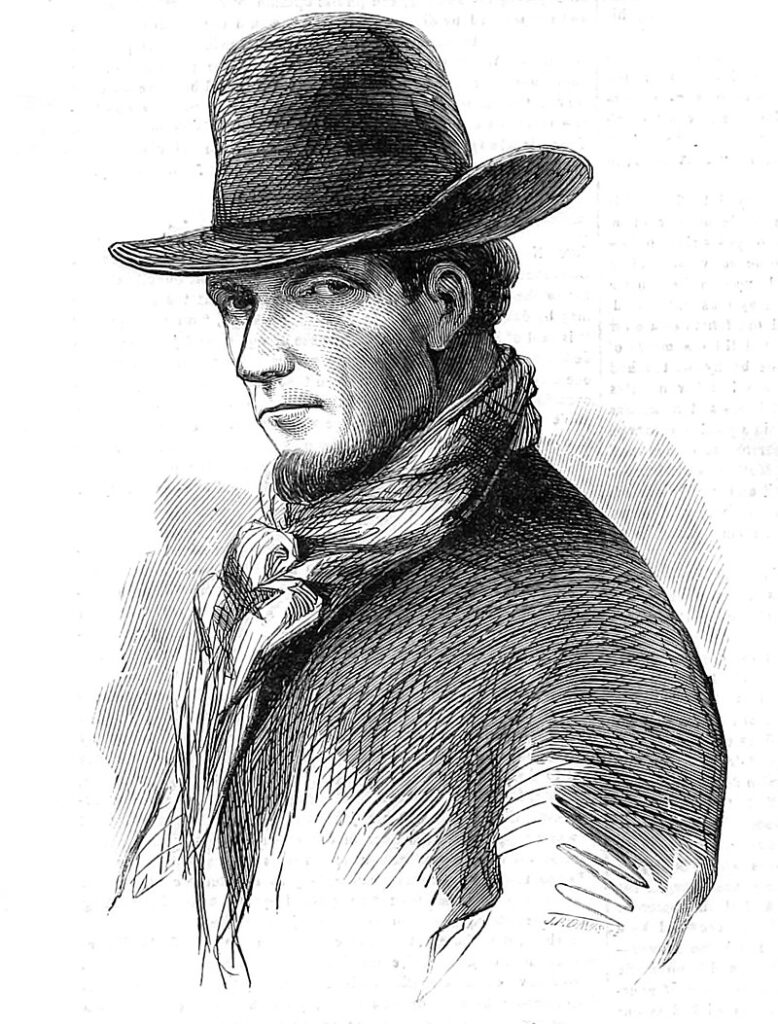
The Antebellum Era had pirates! They were not the better-known buccaneers of the Golden Age of Piracy, but they were pirates all the same. Much of the piracy that occurred in Antebellum America was from two different criminal entities—those who were known as river pirates and those who were mutineers sailing the high seas. The river pirates were domestic gangs who operated along major rivers, especially the Mississippi and Ohio, whose primary targets were smaller river transport vessels, such as keelboats, rafts, and flatboats that had only a small crew. They committed robberies, thefts, kidnappings, and, at times, resorted to murder. River pirates were savage crews with little concern for anyone else’s welfare but their own and represented a significant problem for commerce on inland waterways.
But the focus of this week’s blog is on pirates of the high seas and more specifically, one in particular. For the most part, pirates of the high seas during the Antebellum Era, were paid crew members of merchant ships that transported passengers and cargo to many ports in the United States, as well as, foreign ports around the world. These merchant ships, like the keelboats and rafts that domestic river pirates ambushed, were an integral component of local economies. They carried valuable cargo to and from various domestic and foreign locations that people relied on for their daily lives. Items such as cotton, spices, sugar, coffee and tea, tools, textile goods, and often large sums of money. Cargoes that people not only depended on but also very much desired. Disruption of deliveries by an act of piracy was a significant loss for local communities.
Most of these commodities were transported by private and corporate-owned entrepreneurs. A captain and his officers commanded the vessels. Those under the command staff were regular sailors who were paid to be the ship’s crew. Many of them had years of experience in their trade and were resilient to say the least. The high seas had many challenges, and the ship’s journeys often lasted for weeks and at times months. The sailors were at constant threat of sickness, injury, or death because of relentless storms, filthy on-board living conditions, inadequate sleeping quarters, onboard fighting, accidents, and insufficient supplies of food and water. Still, for most of them, these factors did not deter them from joining a crew. These sailors found the experience thrilling, adventurous, and would not have traded it for any other land-dwelling occupation. This was the fateful course that a fifteen-year-old young man named Albert E. Hicks, living on a farm in Rhode Island in the 1830s, decided was his calling.
Albert lived on his family’s farm and later admitted that farming was rigorous and monotonous work that he intended to leave behind at his first opportunity. He had dreams of leading an adventurous, reckless life that would lead to fame and fortune and free him from the constraints placed on him by others. He was captivated by stories of long ago told by people in his community about treasures of gold and silver buried in the surrounding neighborhood by pirates.
One night, as the family slept, Albert decided it was time for him to leave, roam the world, and seek his fortune. He gathered as many of his possessions as possible and, with what little money he had saved, fled the family farm to Norwich, Connecticut. There he hid outside of the city’s train depot until it was dark. When night fell, he entered the depot. Noticing a package left unattended, he grabbed it and ran into the nearby woods. There, he opened the stolen package only to find a few pieces of lace and silk. Demoralized, he felt his best option was to return home, sell his piddly bounty, and replan for the next time he was to leave. His next adventure away from home came quickly!
People at the train depot saw Albert steal the package and notified the police. The police were quick to track him down to his family’s farm. In the dead of night, the police entered the Hicks’s house, handcuffed Albert, and took him back to Norwich for trial. He was swiftly convicted and sentenced to eighteen months confinement in the Norwich jail. But being the resourceful fifteen-year-old he was, after a few months of his sentence, he managed to escape, only to be rearrested and ordered to hard labor in a rock quarry. Resolute as he was, Albert managed a second escape. This time, when he was found and returned to the jail, he was ordered to spend the remainder of his detention—over a year—in solitary confinement. His time in solitary confinement had an overwhelmingly adverse impact on his state of mind about people and the world. He became obsessed with the idea that he had been persecuted and mistreated. He was determined to seek vengeance against the world and anyone who attempted to interfere.
When Hicks was released from prison, he returned to his family’s farm, but for only a short period. His prison time had hardened his resolve to explore the world and make a fortune for himself. So, he journeyed to Providence, Rhode Island, where he convinced the captain of a whaling ship, the Philip Tabb, to allow him to join the crew. After Albert and his newfound associate, Tom Stone, failed at a bloody attempt to take the ship. He was subsequently shackled and imprisoned until the vessel reached its next port at Wahoo, Georgia, where he was turned over to authorities.
But he had a turn of luck when the captain of a Dutch ship, the Villa de Poel, was so desperate for a crew that he secured Hicks’s release with the condition that he would join the ship’s crew. Hicks agreed but failed in this commitment to the captain. He was unceremoniously released for insubordination and violence. Undeterred, Hicks and Stone joined the crew of the ship, Fanny, but once it made port in California, both men deserted. Hicks explained in later years that he and Stone spent several years in the California region robbing and pillaging as they chose, never thinking twice about murdering whoever was in their path. At one point, the two men set up camp at a Salinas, California, gold camp, intent—not on gold mining—but on stealing as much gold as they could from the bounty of other miners. This was a dangerous endeavor. The gold mining camps of the period had their own form of law for thieves. With no local law enforcement readily available, the miners often held their own quick trials and usually hanged those deemed guilty of violence or theft. But Hicks and Stone were never discovered and left the mining camps with a large bounty of gold. Their next stop was San Francisco, where they exchanged their gold for coins.
In San Francisco, their disruptive behavior soon drew the attention of law enforcement, and believing they would soon be arrested, the two men joined the crew of a ship headed for Chile. The Josephine was carrying a large amount of gold dust and hundreds of Mexican gold coins. The men set plans to steal the entire ship’s cargo. This was Hicks’s first successful mutiny as a pirate! One night, he and Stone ambushed the captain and officers, forcing them to abandon ship. They then loaded the ship’s treasure into another boat, set the Josephine on fire, and sailed to Mexico.
Over the next several years, their ventures followed the same criminal methods: join as crewmembers of ships, mutiny, burn the boat, and move on to the next victim. But off the coast of Ireland, the ship they were on became caught in a deadly hurricane that pushed the vessel into the rocks of the Blackwater Backs. The ship was destroyed, and everyone onboard—over eight hundred people—was killed. The only survivor was Hicks; even his long-time companion, Tom Stone, was killed in the storm.
A few years later, during a layover in England, Hicks, uncharacteristically for his lifestyle, married a local woman. The couple sailed for New York and eventually rented an apartment near the docks. Here, Hicks was able to study the ships preparing to depart as well as the cargo the vessels were loading. In this way, Hicks was able to join ships that had the best opportunity for mutiny and the greatest return for the chance he was taking. Such was his intent when he joined the sloop E. A. Johnson. The boat was carrying about one thousand dollars on board and had a small crew consisting only of the captain, George Burr, and two brothers, Oliver and Smith Watts.
The E. A. Johnson left New York Harbor on March 16, 1860, with its crew and Hicks, who had gained access to the boat under the alias William Johnson. On March 20th, in New York Bay, the E. A. Johnson collided with a schooner, the J. R. Mather, that was headed for Philadelphia. The captain of the J. R. Mather reported that the E. A. Johnson appeared to intentionally turn directly into his schooner as they were passing. The captain reported that the Johnson appeared to be deserted, and he heard no cry for help but believed he saw a shadowy figure moving about the deck of the vessel. That figure was Albert Hicks. Hicks had attacked each of the three crew members during the night and had violently slaughtered them with an axe. He disposed of their bodies overboard, loaded his bounty into a smaller boat, and turned the E. A. Johnson into the Mathers in an attempt to escape discovery. The Mather struggled to return to port, and two tow boats were dispatched to pull the drifting Johnson into port for inspection.
Upon examination of the Johnson, authorities found a grisly sight of blood everywhere and no bodies anywhere. There were indications of bloody tracks across the deck as if someone or something had been dragged from below deck to the side of the deck, but no living person was found aboard the Johnson. The docking of the Mathers drew a curious and shocked crowd. The investigation began to unfold when two men notified the police that a man they knew named William Johnson had been aboard the Johnson when it left port. They added that the man, Johnson, had returned home early from the ship’s journey with a lot of money. They also informed the police that the same man had left unexpectedly with his wife and child.
After many days of tracking Hicks, the police were led to a house in Providence, Rhode Island. Hicks’s wife was found there, and when the police notified her that they were searching for a man named William Johnson, she told them she did not know any William Johnson. She knew her husband, Hicks, was inside the house, but didn’t know he had been using the alias William Johnson. She innocently allowed the police to enter for a search, and it took them very little time to find Hicks on the bed, hiding under a pile of covers. The police were confident they had found their man and began questioning him about a fictitious counterfeit crime. Hicks denied knowing anything about it and stressed to the police that his name was not William Johnson, but rather Albert Hicks, complaining that their questioning was clearly a case of mistaken identity. The police were unconvinced. They arrested him and transported him back to New York, where two witnesses identified him. Captain Burr’s watch was also found among Hicks’s possessions, along with two canvas bags known to have belonged to the crewmembers of the E. A. Johnson. Hicks was formally charged with piracy and murder.
His trial began in May 1860, in front of a packed courtroom of angry and volatile onlookers. It lasted six days, and after the closing arguments, it took the jury only seven minutes to convict Hicks of both counts: piracy and murder. The judge immediately passed the sentence of death by hanging. Hicks continued to deny his involvement in the murders while awaiting his sentence, but a month after his guilty verdict, he decided to confess, hoping his wife would have the transcript published and have some means of support after his death. The court provided him with a clerk to record his statement, which resulted in an autobiography describing his childhood and life’s ventures, including his criminal activities.
On June 13, 1860, Albert E. Hicks was escorted under police protection to his gallows erected on Bedloe’s Island, the future home of the Statue of Liberty. There, with thousands of spectators, on land and in boats, he was hanged by the neck until dead. He was forty years old.
NEXT WEEK 8/17/25…The issue with the Mill Girl Sarah Marie Cornell!!!