During the Antebellum Era, the roles of women experienced a transformative shift due to social changes and rapidly emerging opportunities. Early in the era, in rural America, people were dependent on agriculture, and most of the population made a living and raised families on farms. Women were instrumental in the success of a rural family’s survival. They cared for the children, cooked, cleaned, made clothes for everyone in the family, tended the family garden, and, when necessary, worked the crops in the field and tended to the livestock—both jobs predominantly taken care of by the father/husband. The rural family acted as a team with one component dependent on the other for success. For women living in an agrarian economic environment, the home and workplace were the same. Unlike their counterparts living in cities, there was no distinct division of labor. Out of necessity and because it was impractical for a family’s survival, the “cult of domesticity”—the belief that women should confine their efforts strictly to the home”—was absent.
However, as cities advanced economically and urban populations grew, the work of men and women tended to change. It was often the case that men worked outside the home in offices, factories, shops, and other workplaces, earning money to support the family. It was no longer essential that women earn money for family survival. Their responsibility evolved into one in which women were expected to fill the role of moral guardians of their home and family. This was the essence of the “cult of domesticity,” especially in middle and upper-class families, but also on a less defined level in lower-income communities.
Women were expected to act and behave in specific ways that demonstrated they were pious, pure, domestic, and submissive. These separate spheres—men as the “breadwinner” in the public sphere and women as the “keeper of the house” in the private sphere— characterized a distinct hierarchy of personal and social realms in relationships. Women still maintained a degree of autonomy, but their independence was predominantly restricted to the boundaries of their roles within the “cult of domesticity.” Their spheres of influence revolved around the responsibilities of motherhood and the expectations of being devoted wives. Within this framework, their agency was heavily woven into the fabric of home life.
However, the boom of commerce brought on by the Industrial Revolution forever changed the work and gender dynamics in the United States, especially in the Northeast. The new world of mechanized factory production had a major influence on the social structure of both rural and urban people. The new technology meant changes in the workforces of both rural and urban men and women, but especially for women. Females were attracted to factory employment because it provided higher wages, better benefits, a chance to learn a new trade, a sense of adventure, and greater independence than they were used to working on their family’s farm or in a private household. However, the thousands of females who flocked to the factories in cities often overlooked factors related to the intense working environment. Many of the female workers came from modest rural environments and were not acclimated to the long hours, grueling labor, and dangerous work environment in factories. As well, they had catapulted themselves into a social setting that was far different from the home life they left behind. Urban cities were overcrowded, were breeding grounds for illnesses and diseases, and had a social hierarchy that these women were expected to adapt to quickly. The possibility of engaging in “frowned-upon” behavior was constantly present, and many of the younger mill girls were not adequately or socially prepared to address these types of pressures. This is the environment a mill girl named Sarah Maria Cornell found herself in Lowell, Massachusetts, in 1848.
Sarah was born in 1803 in Vermont and had several other siblings. Sarah’s mother, Lucretia, married her husband, James Cornell, against the wishes of her wealthy father. James was reckless with money, and when his father-in-law refused to provide any more money to him, James deserted the family. Lucretia relocated with her children back to Connecticut, her birthplace, where Lucretia’s father had agreed to support them. When Lucretia’s father died in 1810, he left her insufficient funds to care for her children, so she sent her children to live with various relatives. Sarah was sent to live with an aunt, where she struggled to integrate into her new community.
At the age of fifteen, Sarah became an apprentice tailor under the supervision of a difficult mentor. By the time she was eighteen, the unbearable work environment compelled Sarah to desert her apprenticeship to seek a more amicable opportunity elsewhere. She traveled to Providence, Rhode Island, to visit a sister she had lost contact with when they were younger. Providence was a bustling, vibrant city that Sarah had never experienced before, presenting a setting that she found difficult to adjust to. On one occasion, she was caught stealing some clothing from a local store. Luck was with her on this occasion. The store owner did not file a complaint against her because all his merchandise was returned. On another occasion, she bought a new dress on credit, but was unable to make the payments. Publicly and privately shamed, she decided to leave Providence and return to Connecticut.
Sarah’s dream was to open and operate her own tailoring business, but lacking the funds required for that venture, she decided a change in her life was necessary. Sarah began taking jobs in textile mills as a weaver and loom operator. Dissatisfied with her positions in any one mill, she moved from location to location until, in 1828, at the age of twenty-five, she finally settled in a boarding house in Fall River, Rhode Island, a small town about five miles from Lowell, Massachusetts, where she found a job at a local textile mill.
At the time, the Second Great Awakening was sweeping across the country. Lowell and Fall River were no exception. The religious movement welcomed interested worshippers into their revival and tent meetings, where preachers offered the possibility of salvation for both men and women. Sarah saw the movement as a chance to be accepted without judgment for her past indiscretions. She became a regular attendee at the movement’s revival meetings and, in 1832, was baptized in Lowell as a member of the Methodist Episcopal Church. It was about this time that the church congregation installed a new elder, Ephraim Kingbury Avery. Reverend Avery was a young preacher who was married with children, and the congregation was hopeful that his energetic passion and enthusiasm would appeal to both older and younger community residents and revive the church’s dwindling membership. It was in this setting that Sarah became acquainted with the new reverend.
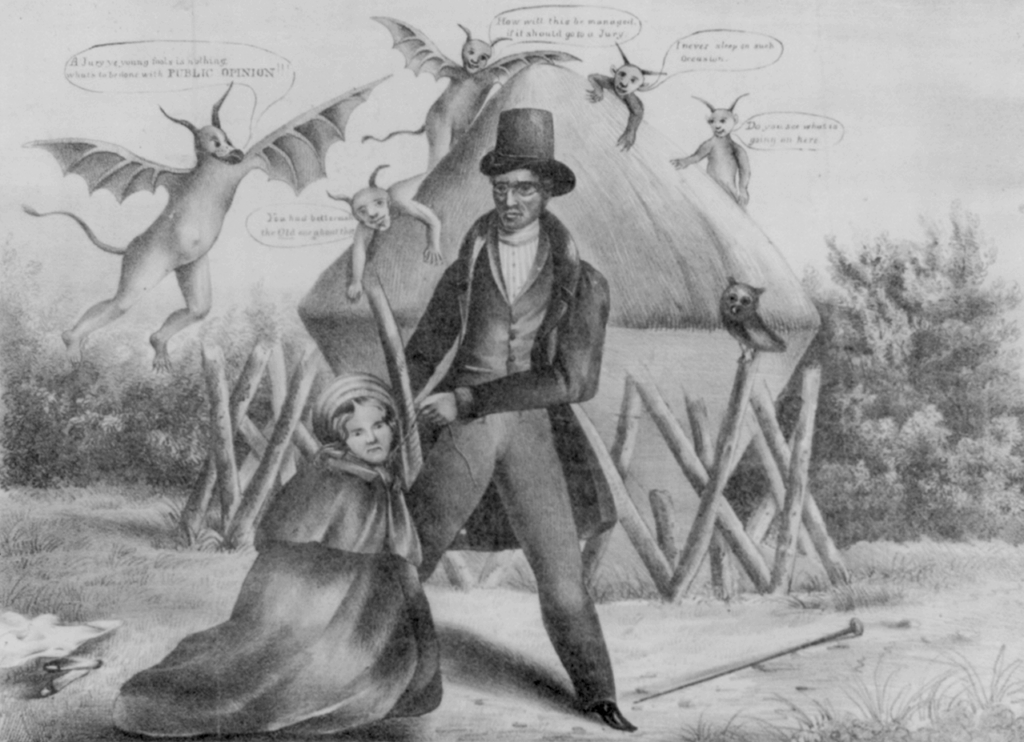
On a frigid morning in late December of the same year, a local farmer named John Durfee was returning to his farm after watering his horses at a nearby stream when he noticed something startling. In a field next to a tall cone-shaped haystack, there was what appeared to be a body hanging from one of the support posts holding the haystack together. As Mr. Durfee approached the haystack, he realized it was indeed a body. The nearly frozen corpse was dangling from a rope tightly tied around its neck. He brushed away the body’s long hair to look at the face and realized it was a female. He described the corpse as wearing a long cloak with the hood covering the head. The legs of the body were tied back at the knees so that the knees were only a few inches off the ground. There was a set of clothes neatly folded on the ground directly under the knees of the corpse. Several feet away, he noticed a frozen red bandana lying in the dirt.
Mr. Durfee called nearby men to guard the body, and he went into town to notify the local coroner. Both men and a small contingent of curious townspeople quickly returned to the haystack. As a closer inspection of the body began, a young woman from the group shouted that the corpse was that of Sarah Cornell, a coworker in the local mill. The young woman informed the men on the scene that Sarah was living in Mrs. Hathaway’s boarding house in town. Two men were sent to the boarding house to collect Sarah’s personal effects and were instructed to bring a doctor with them when they returned. The men returned with a doctor and Sarah’s belongings, including a locked bandbox.
A key was located among Sarah’s clothes which unlocked the bandbox. The contents inside consisted of four letters, three of which had been opened, and one that was sealed and addressed to a person named Reverend Ira Bidwell. Next to the letters was a small slip of paper and a pencil. The initial conclusion at the scene of the body was that Sarah had committed suicide. But that conclusion changed at the formal inquest, when the doctor placed into the record that Sarah at the time of her death was pregnant, with a half-grown fetus. Additionally, the sealed letter in Sarah’s bandbox was opened, revealing that she wanted to meet with the person with whom the letter was intended to discuss a matter of great importance. The slip of paper found with the letters contained two short sentences. “If I am missing, inquire of Rev. Avery, Bristol. He will know where I am gone.” The preliminary conclusion that Sarah had committed suicide was quickly abandoned and changed to murder.
The inquest jury resolved that Sarah had died by hanging or choking, involving one or more assailants. As well, the inquest concluded a person of primary interest was Reverend Ephraim Avery, who should be promptly located and detained until evidence indicates his release would be appropriate. The townspeople of Fall River quickly formed a vigilance committee and traveled to Bristol to locate Rev. Avery. When they arrived at the minister’s house, members of the committee entered and confronted the minister with the evidence of the letters. The reverend denied knowing anything about the letters or about Sarah’s death. The vigilance committee was not convinced and returned the Reverend to Fall River, where they obtained a warrant for his arrest and detention. However, because of his position in the community, Rev. Avery was released from custody and confined to his home in Bristol until a trial could take place. The citizens of the community were enraged that Rev. Avery had been released, arguing that he should not be given preferential treatment for such a heinous crime. The feelings of most people in Fall River that the Rev. Avery was undoubtedly going to escape justice intensified.
Rev. Avery, realizing public sentiment against him had fanatically increased to the point that he feared a mob would kidnap him and secretly take him to a secluded place to hang him, evaluated his situation and fled the area. Once his absence was discovered, a Fall River sheriff named Colonel Harvey Harnden was hired to search for the fugitive reverend. His search ultimately led him to the house of a Mr. Mayhew in Boston. When confronted, Mr. Mayhew initially denied knowing the whereabouts of Rev. Avery, but as the reverend attempted to escape from Mr. Mayhew’s house, the reverend was overpowered, wrestled to the ground, and taken into custody.
The trial did not begin until nearly a year after the murder. At trial, the reverend had no believable alibi for himself. He pleaded that the night of Sarah’s murder, he had been invited for tea by a friend, but declined. Instead, he insisted, he went for a nature walk to enjoy the countryside from early afternoon to about 9:00 p.m. The prosecution presented a definitive account of the murder and Rev. Avey’s involvement. They contended that Sarah requested a meeting to discuss what she and the reverend—the presumed father of the child— should do about her pregnancy. The reverend agreed to the meeting and, carrying several different instruments inside a red bandana, walked Sarah just past Mr. Durfee’s farm next to a tall haystack. There they sat while Rev. Avery explained to Sarah that she could avoid disgrace and expulsion from the community by allowing him to abort her baby. After initial refusal by Sarah, the reverend convinced her it was her best option to allow him to abort the child.
The procedure was doomed from the beginning and turned out to be a fatal disaster. Sarah, screaming in pain and bleeding profusely, fell semi-conscious onto the ground at the bottom of the haystack. The reverend, in a panicked state, ran to a nearby wagon in the field where he found a bag made of burlap. He tore several strands of material from the bag, returned to Sarah, wrapped the strands around her still living body, and tightened them as she gasped until she finally died. The reverend then tied one end of the rope to the top of a haystack support pole and, lifting Sarah’s body off the ground, pulled the rope until the body was elevated off the ground.
After several weeks of testimony and presentation of evidence in front of a courtroom that was filled every day, the jury finally received deliberation instructions from the judge. The following day, the jury indicated to the judge that they had reached a verdict. The defendant was brought before the court. The court clerk addressed the members of the jury, asking them, “How say you find the prisoner guilty or not guilty?” The foreman assertively replied, “NOT GUILTY.” The reverend was immediately released and left the courthouse to stay with a friend for a short time until a boat could be procured to transport him back to his home in Bristol.
But the court of public opinion is a powerful force. Townspeople all across the area took every opportunity to protest the outcome of the trial by regularly burning the reverend in effigy. The reverend, fearing for his life and the lives of his family, decided to leave the ministry. He moved his family to Connecticut, where he worked as a carpenter for several years. His last move was to Pittsfield, Ohio, where he took up farming until he died in 1869, over three decades after the death of Sarah Maria Cornell.
Coming later this week, The Mummy Man, and his influence on America!